

Evelyn Taocheng Wang: Being Poetic Ruins Life
25 Sep 26 — 13 Dec 26
Exhibition
Venue: Goldsmiths CCA, St James', New Cross
“I see the womb as an organ which provides possibility. I think this womb protects me and gives me shelter. It gave me a certain freedom.“— Evelyn Taocheng Wang
Goldsmiths Centre for Contemporary Art presents Being Poetic Ruins Life, the first UK institutional exhibition by Netherlands-based artist, Evelyn Taocheng Wang (b. 1981, Chengdu, China). The exhibition, staged across the CCA’s entire building, offers a comprehensive presentation of Wang’s practice to date, bringing together new commissions and significant works across painting, ink on paper, handscrolls, garments, silk paintings, installation, video and text.
Selected through Wang’s ‘make-up box’ approach, a conceptual lens through which she considers Western art history, and her unreliable narrator ‘The Cultural Whore’, works move between fiction, autobiography and cultural projection. Being Poetic Ruins Life assembles an idiosyncratic portrait of Britain shaped by translation, misunderstanding, desire and performance. Wang describes the exhibition as a “layered womb” —a metaphorical architecture and protective space where ideas can be incubated and identities remain fluid.
The exhibition’s title draws on the history of classical Chinese poetry, a literary tradition where exacting demands often consumed the lives of those who mastered it – who were almost exclusively privileged men of status. The title opens questions around gender, power and creative labour, while also playfully interrogating the romantic notion of “being poetic”; who is permitted lyricism? Whose nostalgia is valued? Can cultural identity be shaped through longing and performance? Throughout Wang’s work, wit, elegance and apparent lightness become strategies for negotiating language, identity and cultural expectation.
At the heart of the exhibition are newly commissioned works responding directly to the British context of Goldsmiths CCA. These explore the Chinese diasporic experience as shaped by migration and tourism, and Britain’s cultural image in China through period dramas, literary translation and popular imagination. Through the figure of The Cultural Whore, Wang approaches Britain’s cultivated mythology – its reserve, coded humour, afternoon tea, social class and inherited melancholy – with affection and irony, embracing the productive possibilities of cultural misreading. The Cultural Whore’s image of Britain is glamorous, colonial, literary and whimsical, prompting her to pull images from sources such as Kazuo Ishiguro’s Remains of the Day (1989), costumes from the film Titanic (1997), and Count Duckula (1988-1993) – one of few non-Communist cartoons to be translated into Mandarin Chinese. These motifs animate her paintings, merging figurative imagery with geometric compositions indebted to Agnes Martin, whose subtle abstractions, restrained palettes and poetic withdrawal from public life have long informed Wang’s practice.
Literature and cinema permeate the exhibition, frequently encountered through translation or adaptation. Wang draws upon Chinese translations of British writers including Jane Austen and Virginia Woolf, and Merchant Ivory films such as A Room with a View (1985) and Howards End (1992). British identity also appears through clothing—including Margaret Howell and Barbour—which become costumes through which The Cultural Whore imagines, constructs and performs Britishness.
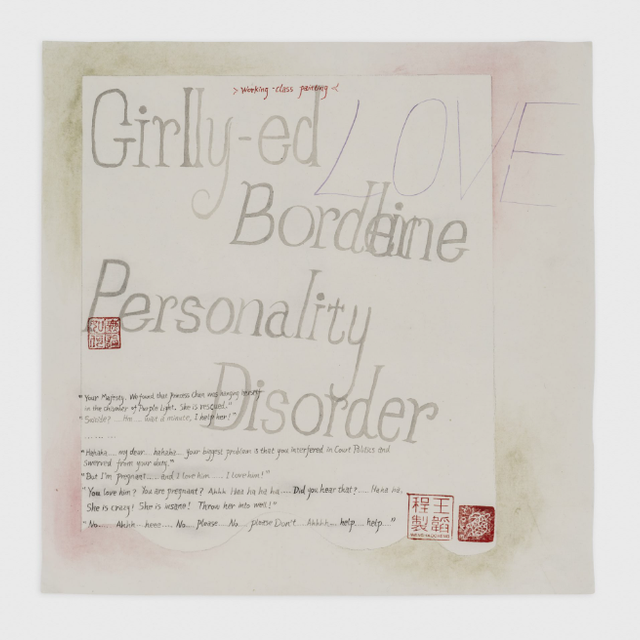
The exhibition’s first floor will present new paintings that echo Agnes Martin’s distinctive visual language while introducing scenes from A Room with a View alongside fragments of dialogue and textual interventions. Such visual and literary quotations deliberately resist stable interpretation, offering what one writer has described as “splattered data-points” that continually redirect viewers back to their own assumptions and cultural biases.
Chinese-American writer Eileen Chang emerges as another significant presence throughout the exhibition. Chang’s own idealised—and often mistaken—perceptions of Britain, together with her personification of a “desolate, ambiguous and lonely” femininity, migration and cultural displacement, resonate deeply with Wang’s practice. Her romantic sensibility, literary voice and influence on writers including Stella Benson and W. Somerset Maugham informWang’s imaginative landscape and appear directly within two large-scale text paintings, or “rubbings”, presented in the exhibition.
New paintings also feature Wang’s recurring motif of chicken wings, which within The Cultural Whore’s personal lexicon signify “happy gossiping”. Gossip, confession, autofiction and diary writing recur across Wang’s canvases, where multiple narrative voices complicate any notion of objective meaning. Surreal juxtapositions of butchered meat and delicate colour gradations foreground painting itself as a cultural language – one capable of speaking to, inhabiting, and gently disrupting the histories of canonical art.
Oversized Positive Energy (2020), is an installation of drying racks displaying oversized “grandmother” underwear that playfully acknowledges the CCA’s former life as a Victorian washhouse and laundry. Throughout the exhibition, scenographic elements, including translucent muslin screens and vitrines displaying eyeshadow palettes, mediate relationships between works. Makeup functions as both material and metaphor within Wang’s practice, referencing the performative construction of identity and the conventions of beauty culture. Wang frequently incorporates cosmetic pigments directly into her works and has described her artistic vocabulary as an “eyeshadow palette of art history”: a repertoire of borrowed colours, inherited references and endlessly recombined cultural identities.
BIOGRAPHY
Evelyn Taocheng Wang’s practice emerges from an interest in what constitutes identity and culture, and how one’s own body is culturally relative to—and intertwined with—autobiographical structures. Evoking multiple personae in her work, Wang interrogates the subject of authenticity, and how we go about performing it. Her practice spans installation, performance, video, sculpture, and a range of painting and drawing styles, while her research is based on various (art) histories, feeding from perceived concepts of East and West, offering fragmented, diary-like views of embodied personal, and external, fantasies and desires.
Born in 1981 in the Sichuan capital city of Chengdu, Wang learned about Soviet Realism, the Russian avant-garde, and European modernism in high school. At Nanjing Normal University, she studied Chinese classical literature, calligraphy, and landscape painting, as well as mathematics and English. In her work she broaches the topic of cultural difference and assimilation, drawing on her multitude of influences to play with language barriers, stereotypes, and material contradictions. An ongoing series includes imitations (or homages) to American painter Agnes Martin, which combine the abstract expressionist’s pared downlayers of mathematical precision with her own contrived motifs and styles. Her work touches on immigration and belonging, interrogating the bureaucratic insignia of authentication and the politics of assimilation.
Language is integral to her practice, allowing her to break into different characters, while using mistakes and discrepancies to negotiate identity and estrangement. Often focusing on the notion of ‘exchange’, imagined and real friendships are unravelled into their fundamental parts, dismantling binary differences between nations, histories, and individuals. Drawing herself into the body of cultural references, Wang’s method is filled with both elegance and incoherence, with an understanding that beauty must remain inexplicable.
Evelyn Taocheng Wang recently opened a solo institutional exhibition at MUSEION Museum of Modern and Contemporary Art, Bolzano. Major solo presentations of Wang’s work have been staged at institutions around the world, including the Museum Ludwig, Cologne; Rockbund Art Museum, Shanghai; the Kunstverein Düsseldorf; the Hermitage Museum, Amsterdam, as recipient of the ABN Amro Art Prize; Museum Abteiberg, Mönchengladbach, Germany; FRAC Champagne-Ardenne, Reims; SMAK, Ghent; KW Institute for Contemporary Art, Berlin, among others. Wang’s work was included in the 60th International Art Exhibition of La Biennale di Venezia curated by Adriano Pedrosa.
Wang’s work is held in several public collections, including The Museum of Modern Art (MoMA), New York; Art Institute of Chicago; Centre Pompidou, Paris; The National Museum of Art, Osaka; Museu de Arte de São Paulo (MASP), São Paulo; and the Stedelijk Museums of both Amsterdam & Schiedam.